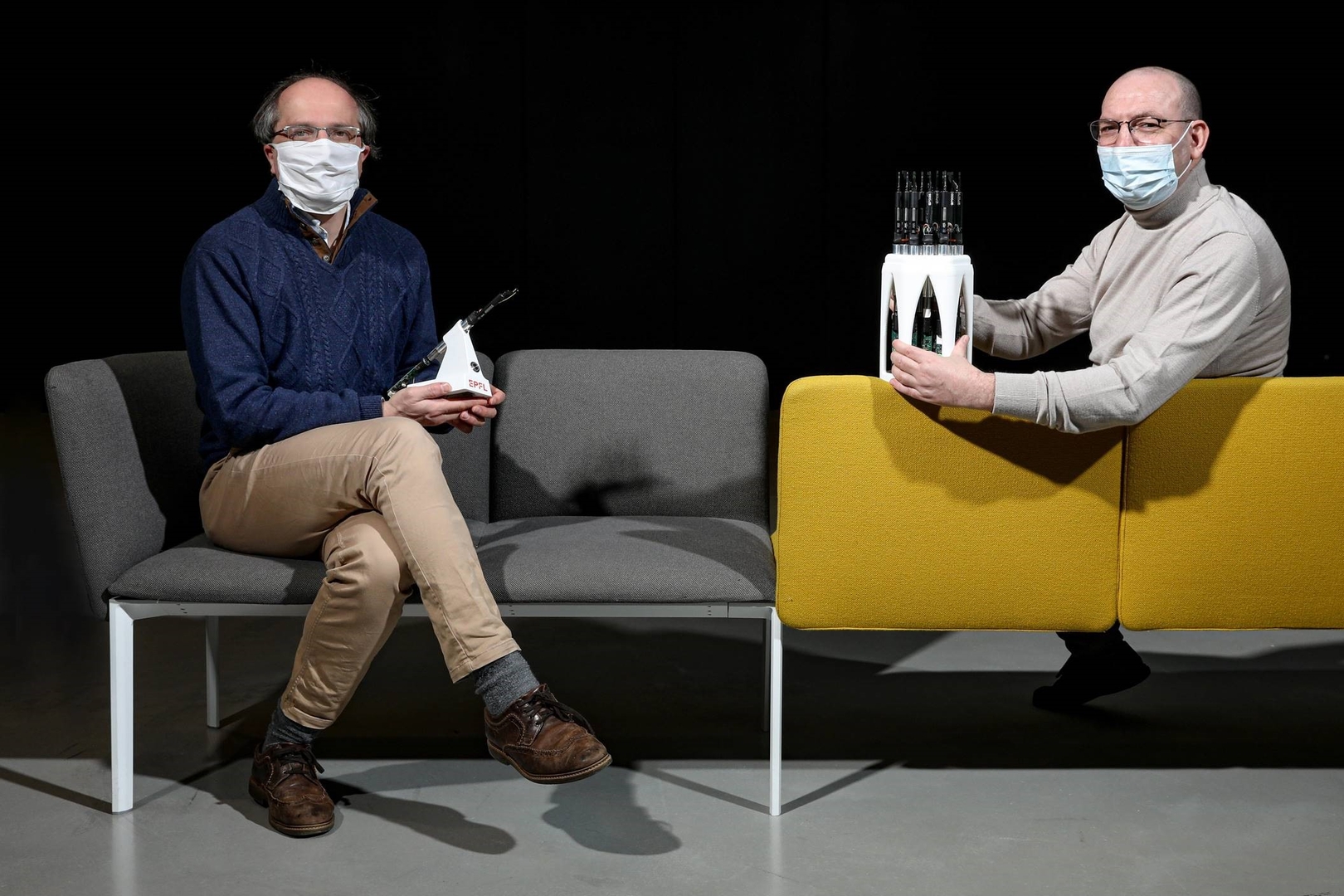
Following the collaboration between EPFL and MPS concerning the development of fiber positioniers to broaden the horizon of astrophysics. Mr. Jean-Paul Kneib, director of the Laboratory of Astrophysics at EPFL has accepted to answer our questions.
MPS: Looking back, could you briefly describe the main challenge of the collaboration between EPFL and MPS and explain how it was overcome?
JPK: The objective of the project was to manufacture robotic fiber positioners for SDSS-V within a relatively short timeframe. These robots were to be deployed on two telescopes. We started with a design and prototypes developed entirely by EPFL, with the requirement that the robots achieve positioning accuracy within a few micrometres after final calibration.
The main challenges were therefore:
In my view, these challenges were successfully overcome thanks to the close collaboration between EPFL and MPS. Several factors were essential:
MPS: What is your fondest memory of this collaboration?
JPK: The excellent working relationship and the steady progress of the project, despite the various difficulties we encountered and ultimately overcame together. These included technical and organisational challenges, as well as external disruption caused by the COVID-19 pandemic.
MPS: You equipped two telescopes with thousands of optical fibers. Is there a broader trend in astrophysics towards deploying this type of technology on other telescopes?
JPK: Yes, this is clearly the direction in which astrophysics is moving. We now have increasingly sensitive detectors that allow us to locate a growing number of objects across the celestial sphere, including stars, galaxies, quasars and supernovae.
However, to characterise these objects, we need to obtain a spectrum for each one. This requires us to acquire many spectra simultaneously. Robotic fiber positioners provide an effective means of performing highly multiplexed spectroscopy, allowing numerous objects to be observed in parallel. This enables us to determine their distances and physical properties.
MPS: The article mentions the search for dark matter. Looking ahead, who is likely to see definitive proof of its existence and learn about its properties: my parents, who are now 60, me at the age of 23, or my children?
JPK: In my view, we already have very strong evidence that dark matter exists. What we do not yet know is its precise nature—particularly the properties of the hypothetical particles that make up dark matter.
For example, we currently know the density of dark matter in the vicinity of our galaxy, but we do not know the mass or size of its constituent particles. Over the next five to ten years, astronomical observations—and possibly experiments at CERN—should allow us to place tighter limits on the possible mass of these particles. They may also help us determine how strongly, if at all, dark matter interacts with baryonic matter, which is made up of protons, neutrons and electrons.
We would like to thank Jean-Paul Kneib for taking the time to answer our questions and wish him every success as his remarkable career continues.